
Do you need stump grinding after forestry mulching?
Only where the ground has a job that stumps interrupt. A forestry mulcher grinds trees and brush to ground level, but it leaves the stumps at grade and every root in the dirt. For pasture, habitat, and trails, that is finished work. For lawns, food plots you disk, and anything you build on, the stumps in those footprints need a grinder.
That one distinction decides thousands of dollars on a clearing job, so it is worth understanding exactly what forestry mulching leaves behind and where stump grinding picks up.
What a mulcher actually leaves on the ground
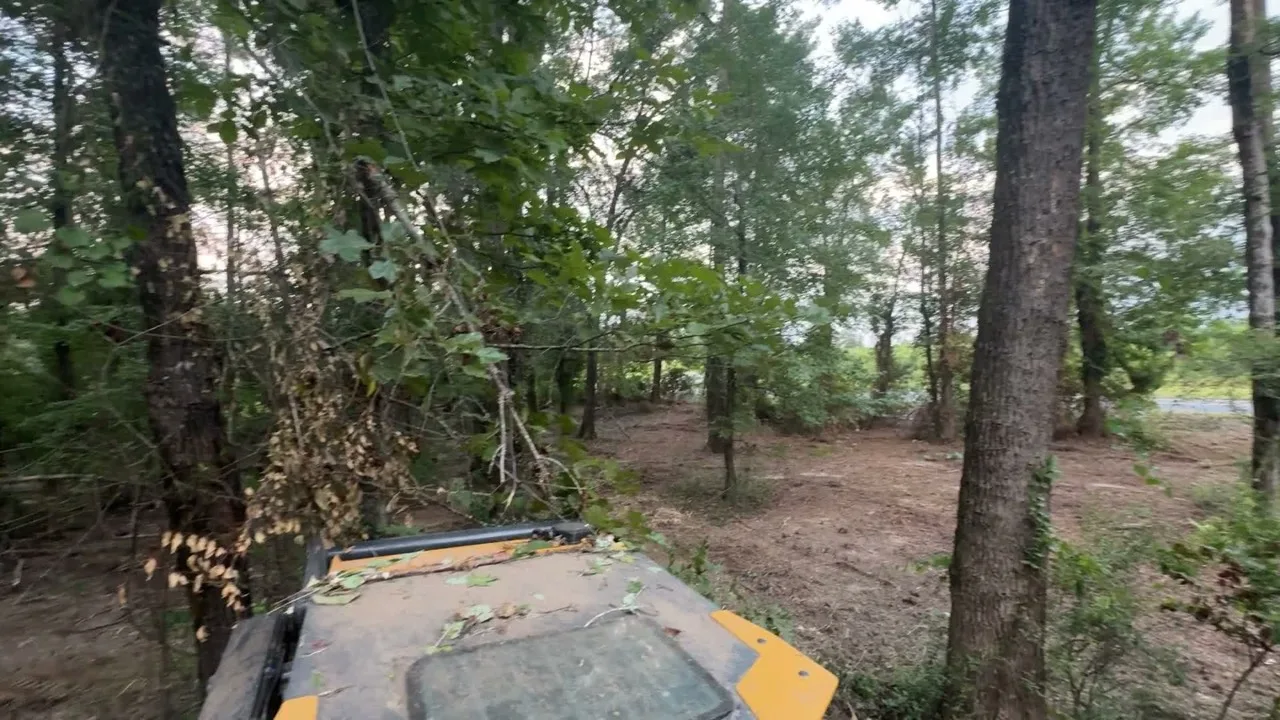
A forestry mulcher is a shredder on the front of a tracked machine. It takes standing brush and trees, grinds them where they stand, and spreads the chips across the ground as a mulch layer. Nothing is hauled, nothing is burned, and the topsoil never gets scraped up the way it does under a dozer blade.
What it cannot do is work underground. The equipment makers themselves are direct about this: a mulching head can shave a stump roughly flush with the surface, and pushing it a couple of inches below grade mostly grinds up the machine’s teeth instead of the stump. The root balls stay put. So after a mulching job you have open, walkable ground with low stubs scattered through it at about surface height and the entire root network still underneath.
A purpose-built stump grinder is the underground tool. It cuts 6 to 12 inches below grade per pass, which is what turns a stub into a spot you can till, mow, or build on.
Where mulched ground is already finished
Most of the acreage we mulch around Northeast Louisiana never needs a grinder, because most of it goes back to work as cover.
Pasture and field edges stay ahead of the stubs as long as they get an annual mowing pass, and a rotary cutter set at working height rides over grade-level stubs without complaint. Hunting land is the classic case. Shooting lanes, cleared bedding edges, and mulched travel corridors on wildlife habitat work exactly as intended with the stubs left to rot under the mulch. Trails, fence lines, and view corridors are the same story. The stubs decay in place over a few seasons, the mulch layer holds the soil and feeds it, and nothing about the land’s job requires bare dirt.
There is even a soil argument for stopping there. Mulching leaves the root mat that holds ground together, so slopes and creek banks keep their structure, and the low ground pressure of a tracked mulcher matters on soft Louisiana bottomland where heavier clearing methods leave ruts.
Where you need the grinder to follow
The rule that sorts it: if equipment or a structure will touch that exact ground, the stumps there have to go below grade.
| What the ground will become | Grind the stumps? |
|---|---|
| Pasture, bush-hogged fields | No |
| Wildlife habitat, shooting lanes, trails | No |
| Lawn you will mow | Yes, in the lawn area |
| Food plot you will disk or till | Yes, in the plot |
| House, shop, or barn pad | Yes, and deeper grinds or removal under the footprint |
| Driveway or gravel road | Yes, along the route |
| Septic tank and drain field | Yes, and keep roots clear of the lines |
Lawns and plots are about steel meeting wood. A mower blade or a disk gang finding a hidden stub at speed is a repair bill, so plot ground gets its stumps ground flush or below before anybody tills it. Pads and driveways are about what happens later: a stump left under a slab keeps decaying, and decaying wood becomes a void under something that must not settle. Contractor practice on septic areas runs the same direction, with stumps ground well below grade around drain fields and roots kept away from the lines.
The good news is how little of a typical tract this covers. On forty mulched acres, the lawn, plot, and pad footprints might be two of them.
The regrowth question nobody asks until year two
Mulching does not kill hardwood rootstock, and honest operators say so up front. University field research on masticated ground found woody resprouts coming back within the first growing seasons, and untreated sites working their way back toward brush over several years. In our country that means sweetgum, tallow, and privet trying again.
The fix is maintenance, not regret. An annual bush hogging pass keeps resprouts from ever getting woody. A follow-up herbicide treatment on the regrowth is the strongest single move, with field trials showing spot treatments controlling the large majority of resprouting at modest per-acre cost. And on the specific stumps you had ground, the regrowth odds depend on species, which we cover in will a stump grow back after grinding.
The money math: mulch it all, grind what matters
This combination is the whole reason the two services exist side by side. Market rates put mulching at roughly $500 to $2,000 an acre for light to medium growth, while traditional grub-and-haul clearing on wooded ground runs $3,600 to $5,600 an acre. Full clearing buys you bare, stump-free dirt across every acre, and most tracts simply do not need that.
So the standard play is: mulch the whole tract, then bring the grinder to the footprints that matter, at market rates of roughly $40 to $150 per stump when a batch gets done in one visit. Our stump grinding cost guide breaks down that per-stump math. On a typical homesite tract, mulching forty acres and grinding the two that become yard and plot costs a fraction of clearing forty acres to bare dirt, and the other thirty eight keep their topsoil and their cover.
Sequence matters, and it is simple: mulch first, so the standing growth is down and every stump is visible, then grind the marked footprints. Done in one mobilization, it is one trip charge instead of two.
FAQ
Does forestry mulching remove stumps? No. A mulching head grinds standing trees and brush down to ground level and can shave a stump roughly flush with the surface, but it does not remove the root ball or work below grade the way a stump grinder does. The stumps stay at or near the surface and the root systems stay in the dirt.
Will a forestry mulcher grind stumps below the ground? Not meaningfully. Equipment makers put it plainly: a drum mulcher can nibble a couple of inches below the surface, at the cost of chewing up its teeth, while a purpose-built stump grinder cuts 6 to 12 inches per pass below grade. If a spot needs clean, stump-free dirt, it needs the grinder.
When is mulched land fine without stump grinding? When the ground will stay in cover: pasture you bush hog, wildlife habitat, shooting lanes, trails, fence lines, and view corridors. The low stubs decay under the mulch layer and never bother anything taller than a rotary cutter. Most hunting-land mulching never needs a grinder at all.
When do I need stump grinding after mulching? When equipment or structures will touch that exact ground: lawns you will mow, food plots you will disk, building pads, driveways, and septic areas. Stubs at grade hit mower blades and disk gangs, and stumps left under pads decay into voids. Grind the stumps in those footprints and leave the rest.
Does brush grow back after forestry mulching? Hardwood brush usually tries. Mulching does not kill the rootstock, and university field research found resprouts within the first seasons, with untreated ground working back toward brush in a few years. A maintenance pass, bush hogging on a regular schedule, or a follow-up herbicide treatment keeps mulched ground open.
Is mulching plus selective stump grinding cheaper than full clearing? Usually by a wide margin. Mulching runs roughly $500 to $2,000 an acre on light to medium growth while grub-and-haul clearing on wooded ground can run $3,600 to $5,600 an acre. Mulch the acreage, then grind only the stumps in the lawn, plot, or pad, and you buy clean dirt only where it matters.
What order should the work happen in? Mulch first, grind second. The mulcher takes down the standing growth and turns it into ground cover, which shows you exactly what stumps are where. Then the grinder works just the footprints that need it. Doing both in one mobilization is standard practice and saves a second trip charge.
Plan both passes in one visit
Tell us what each part of the tract is supposed to become and we will mark what gets mulched, what gets ground, and what gets left alone. Call (318) 235-7597 or ask for a free on-site estimate. Big Cypress Land & Game runs forestry mulching and stump grinding across Northeast Louisiana, usually on the same mobilization.