
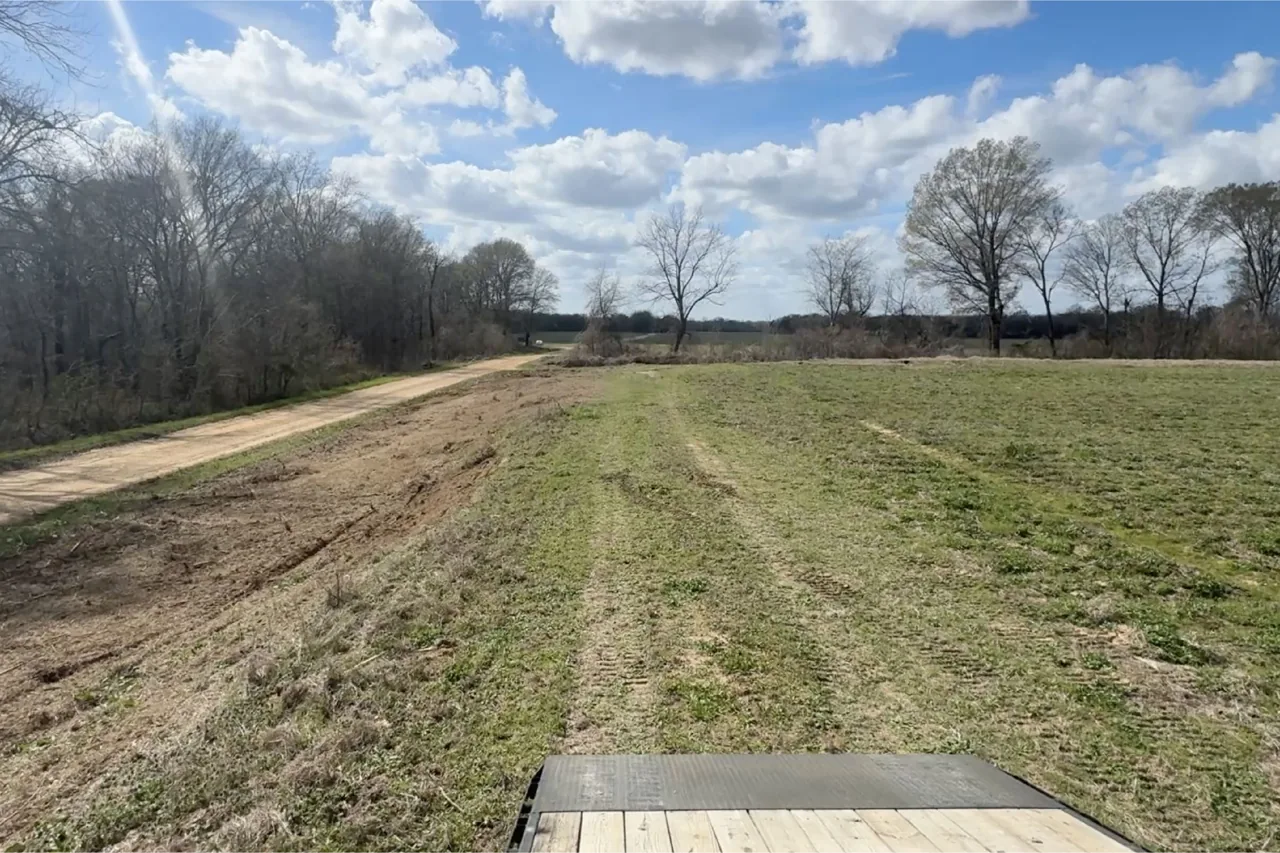
How often should you bush hog pasture and hunting land in Louisiana?
Grazed pasture in Louisiana usually needs bush hogging one to three times between late May and September, timed to seedheads and weeds rather than the calendar. Hay ground runs on its own four-to-five-week cutting cycle. Hunting land is different: cut annual plots once before fall planting and rotate old fields on a two-to-three-year cycle, with no whole-field mowing from April through August.
The schedule follows the grass. LSU AgCenter puts bermudagrass and bahiagrass at the base of Louisiana pasture from April through October, dormant in winter, with bermudagrass peaking May through August. That splits bush hogging on a Richland Parish place into summer clipping for forage and weeds, and a late-winter or late-summer cut for wildlife cover and woody growth.
How often should you bush hog a grazed pasture?
A stocked bermudagrass or bahiagrass pasture in Northeast Louisiana normally gets clipped one to three times a summer. The first pass comes in June, when seedheads and broadleaf weeds get ahead of the cattle. Later passes in July, August or September happen only if weeds rebound. Mow to the weeds, not to a date, and leave stubble behind the cutter.
LSU AgCenter’s forage calendar has you assess broadleaf weeds in summer pasture in June, then “clip pastures for weed control if warranted” in July, August and September. Cattle do most of the mowing on a grazed pasture; the cutter takes what they refuse. LSU’s bahiagrass guide says the grass turns tough and unpalatable at 8 to 10 inches and should be clipped periodically to take the seedheads off. Alabama Extension moves cattle off bermudagrass at 2 to 4 inches so it can regrow, so a clipping belongs above grazing height, not down in the sod.
Weeds set the timing. The University of Arkansas at Pine Bluff’s livestock specialist says to mow weeds before they flower and set seed, and Georgia’s forage team notes that a single pass does little to rootstock perennials such as thistle. Grazing pressure, fertility and a herbicide where needed carry the rest.
Broomsedge is a soil problem before it is a mowing problem. Alabama Extension ties it to low fertility and light early-season grazing. Tennessee’s beef and forage center clips it in mid-July when the brown seedheads show and again in early September, and expects a real decline over about three years once lime and fertilizer are corrected. Mow it without fixing the soil and it comes back.
How often do idle fields and hay ground need cutting?
Hay ground is not bush hogged. It is cut on a quality cycle, about every four weeks for bermudagrass and every 30 to 35 days for bahiagrass once the first cutting comes off. An idle field with no cattle and no hay needs one cut a year to stay a field, and the month you pick matters more than the count.
LSU AgCenter takes bermudagrass at 15 to 18 inches for the first cutting and about every four weeks after. Bahiagrass comes off at boot to early heading, then every 30 to 35 days if growth permits. Wait longer and fiber climbs while protein falls.
Idle ground is where people over-mow. Missouri Extension notes that annual mowing builds dense perennial grass and a litter layer quail cannot move through, and Kentucky’s wildlife agency says mowing an entire field every year is normally not needed to keep it open. If wildlife is not the goal, one cut after mid-August keeps it from going woody. If it is, cut a third each year in late winter and leave the rest standing.
How often should you mow hunting land: plots, lanes, trails and edges?
Annual food plots get bush hogged once, in August or early September, as the first step of fall planting. Shooting lanes and trails get freshened once in August and touched up only as needed. Old fields kept for cover are cut on a rotation, one third of each field per year in late winter, so no more than a third is ever bare at once.
For plots, copy LSU AgCenter’s county-agent sequence. Bush hog the summer weeds, cut around any clover and never take clover below 10 to 12 inches. Wait about a week, spray the regrowth with glyphosate, give it another week or two to die, then disk. If the disked plot sits a week or two before seed goes in, disk again, because weeds are already back. LSU’s statewide wildlife planting guide opens September 1 for wheat, oats and ryegrass, through November 1, and through November 15 for cereal rye and winter clovers. Its agents warn that early September is still too hot and that armyworms hit early, well-fertilized plots hardest; Mississippi’s wildlife department gives “October” as the short answer for most of that state. Perennial clover plots follow Kentucky’s rule: cut once or twice a year, early March or early September.
Lanes and trails are the easy part. Kentucky’s guidance is to mow paths only as often as needed to hold a comfortable walking height. Lanes get freshened in August, after leaf growth is finished and a month or more ahead of opening day, and Arkansas Game and Fish notes that by September trails and firebreaks can be mowed safely.
Old fields and edges are where the cadence flips from months to years. Louisiana’s Bobwhite Recovery Plan says field borders left unmanaged “will quickly succeed to woody brush and then trees,” calls for treating them every one to three years, and lists mowing to control woody brush among its pasture practices. Georgia’s quail biologists work a third of a fallow field each winter and warn that mowing the same portion repeatedly builds mats chicks cannot cross. Mississippi State Extension times wildlife mowing to February and August because fresh regrowth draws the insects poults and chicks live on, and North Carolina State gives the shelf life: quail use a disturbed area for three to four years before woody plants shade it out.
Where the sod allows it, strip disking beats mowing for brood cover. Arkansas Extension runs strips 30 to 50 feet wide with 60 to 100 feet left between them, disked between October 1 and March 15, and says to mow first where growth is too thick for the blades. Do not disk bermudagrass sod, which only spreads it; kill bermuda or bahia with herbicide first. That is the work behind our wildlife habitat service, and the deer version is in clearing land for deer hunting in Louisiana.
When should you not bush hog in Louisiana?
Keep the cutter out of whole fields from April through August. Louisiana turkeys start nesting the second week of April and hens incubate from mid-April to early June, bobwhite hatch from late June into September, and does are still raising young fawns in August. Cut only plots, lanes and trails in that window, and stay off wet clay in any month.
The dates are Louisiana’s own. LDWF’s poult survey puts breeding and egg laying at late March to mid-April, incubation from mid-April to early June, and brood rearing from mid-June through August. Richland Parish sits in the North Mississippi Delta survey region, which posted the state’s lowest poults per hen in 2023, with nesting and brood cover named as a likely limit. The Bobwhite Recovery Plan puts most hatching at late June to September, and Louisiana wing data from 1984 to 1998 showed 80.7 percent of birds hatched in late July or later, so an August whole-field cut lands on the biggest hatch of the year. Mississippi State’s rabbit guidance: if you must mow, wait until October and never mow entire fields.
Georgia says mow in late winter, February through mid-March, and not during the April through September nesting season; Kentucky names late February to mid-March and late August to early September as the best windows; Arkansas asks hay producers to wait until July 15 or later. Louisiana’s hatch runs later than Kentucky’s, so the safe late-summer window here is September. If hay must come off in season, cut from the center outward, leave a 30-foot uncut border, hold the cutter at 6 to 8 inches, and leave native grass alone after September 1 so it regrows into winter cover.
Wet ground is the other stop sign. LSU AgCenter’s northeast wildlife agent describes the local pattern as prolonged flooding into May, June and even July, followed by drought. Weather Service records for Monroe average around 5 inches of rain a month from December through March, near 3 inches in August and September. Sharkey clay swells wet and cracks dry, and Nebraska Extension found that 80 to 85 percent of compaction damage happens on the first pass of the tires. If the tractor is cutting ruts, come back later.
What does a season-by-season bush hogging schedule look like in Louisiana?
Put the two calendars together and a Northeast Louisiana year has six windows. Pasture and hay work runs May through September. Wildlife and woody-brush work runs mid-February to mid-March and again in September. April through August is plots, lanes and trails only, and the wet months at each end of the year are for planning, not mowing.
| Window | Grazed pasture | Hay ground | Hunting land |
|---|---|---|---|
| Mid-February to mid-March | Clip winter-annual weeds in overseeded pasture if grazing falls behind | Service the cutter | Main old-field cut, one third of each field; finish strip disking by March 15; mow thick strips first |
| April to May | Grass breaks dormancy; start grazing at 4 to 6 inches; mower stays parked | First bermudagrass cutting at 15 to 18 inches, usually late May | Hands off cover; turkeys on nests; warm-season plots go in from April 1 |
| June to mid-July | First clip when seedheads and broadleaf weeds outrun the cattle | Every 4 weeks for bermudagrass, 30 to 35 days for bahiagrass | No field mowing; quail hatch begins late June; trails only as needed |
| Mid-July to August | Clip again only if warranted; first broomsedge clip mid-July | Cycle continues | Bush hog annual plots in late August, then spray and disk; trim shooting lanes |
| September to mid-October | Last clip if warranted; graze or clip sod short before overseeding ryegrass | Last cutting in September | Plant cool-season plots from September 1, best odds late September into October; second broomsedge clip; wildlife mowing window; mow trails and firebreaks; fall strip disking from October 1 |
| Mid-October to mid-February | Graze winter pasture; buttercup herbicide in December | Nothing to cut | Leave cover standing; winter disking late October to mid-February; watch for ruts on wet clay |
The pasture and hay rows track LSU AgCenter’s forage calendar; the hunting-land rows track LDWF, Georgia, Kentucky and Arkansas wildlife guidance.
What happens if you skip bush hogging for a couple of years?
A skipped year costs you a heavier cut. A skipped second and third year changes the tool. Annual weeds give way to perennial grass and briars after about two growing seasons, then to woody sprouts, and once stems pass the 2 to 4 inches a rotary cutter is rated for, the job becomes forestry mulching at a different price.
Arkansas Extension describes the sequence: annual plants last one or two growing seasons, perennials take over, woody plants follow, and the pace is set by fertility, rainfall, hydrology and growing-season length. Louisiana’s growing season runs April through November by LDWF’s count, so the pace here is fast. A 3.2-hectare field in northeast Louisiana abandoned in 1984 grew a shrub and young tree layer out of its ground cover and held 16 tree and shrub species by year 16, sugarberry and green ash among them.
The cutter sets the deadline. Bush Hog rates its single-spindle line from 1 inch of brush on the 15 to 25 horsepower models to 4 inches on the 60 to 70 horsepower BH410, and its 15-foot flex-wing at 3.5 inches. Kentucky’s rotational rule, every strip cut at least every three to five years, exists to keep stems inside those ratings. Price moves with the stems: published market ranges put maintained fields at $50 to $75 an acre and fields with saplings at $150 to $250, with a $150 to $250 minimum per visit common. The breakdown is in bush hogging cost per acre in Northeast Louisiana, the tool decision in bush hogging vs forestry mulching. Past 4 inches, forestry mulching grinds stems and stumps in place, and a standing bush hogging schedule is what keeps a field out of that bracket.
Big Cypress Land & Game bush hogs pasture and maintains hunting land out of Rayville across Northeast Louisiana, and we can put a field on a schedule that fits both the cattle and the birds. If you want a look at what your ground needs this season, get in touch and we will walk it with you.