
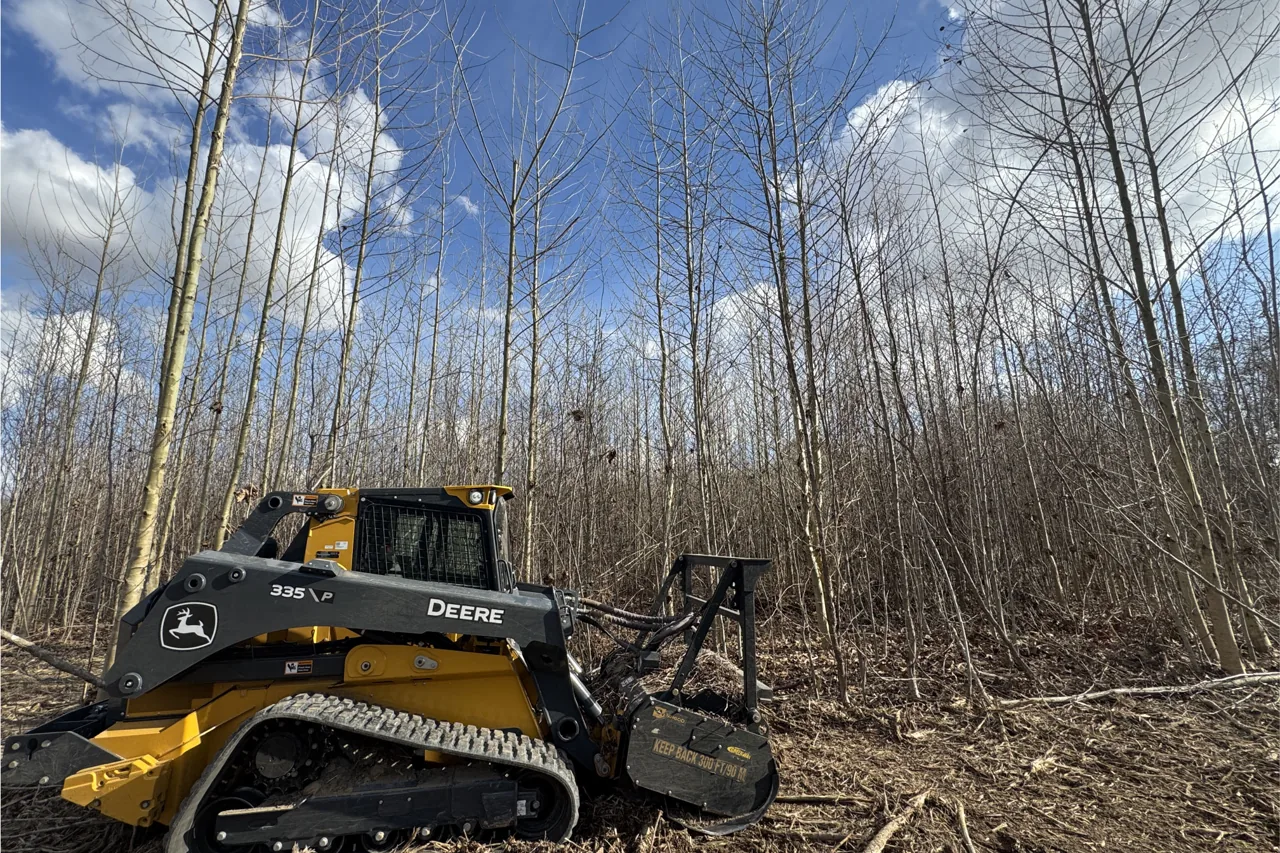
Bush hogging or forestry mulching: which one should you use on an overgrown field?
Measure the stems. If most of what has come up is grass, weeds, briars and saplings under 2 to 3 inches, a bush hog handles it for a fraction of the price. If the field has gone to privet, tallow or sweetgum thicker than your wrist, mulch it first, then bush hog to maintain it.
Both machines knock growth down. They differ in what they can bite, what they leave on the ground and what they cost per acre, and those three things decide the call. We run a rotary cutter and a mulcher out of the same yard, so bush hogging and forestry mulching get quoted on the same tract with no thumb on the scale.
What does each machine actually do to the brush?
A bush hog is a rotary cutter pulled behind a tractor. Blunt blades swing under a deck and shatter stems at a set height, and the cut material falls where it stood. A forestry mulcher is a spinning drum of carbide teeth on a skid steer or tracked carrier that grinds standing trees, brush and stumps into chips.
The cutter’s blades hang on hinges and run dull on purpose, so they whack through stems at tip speeds over 150 miles an hour rather than slicing them. The deck rides at whatever height you set, typically 2 to 12 inches, and everything below that line stays put. The mulcher works from the top down: the operator lowers the drum onto a standing tree and feeds it through, so a 6-inch sweetgum becomes chips without being cut, dragged or burned. Drum heads grind stumps to about grade and leave a fine, even mulch. Hydraulic flow, not engine horsepower, drives the rotor, which is why two machines that look alike differ so much in what they will chew.
How big can the brush get before a bush hog stops being the answer?
Rotary cutters are rated by stem diameter, and the rating tracks machine weight. Bush Hog’s light Razorback line is rated for 1-inch brush, the BH10 line for 2-inch saplings, the medium-duty BH20 for 3 inches and the heavy-duty 320 series for 4 inches. Skid steer mulchers start where those numbers end and run to 8 inches or more.
Those ratings assume the odd stem in a field of grass, not a solid stand. Push a 2-inch cutter through an acre of 3-inch sweetgum and you get shear-bolt and slip-clutch trips all day, a lot of backing up, and stubs left standing. Contractors treat 2 to 3 inches as the working ceiling for a tractor cutter, and hardwood counts against you: one equipment guide puts the limit at 3 inches for softwood saplings and 1.5 for hardwood. Big flex-wing batwings stretch the top end to 4 or 5 inches.
Mulcher capacity runs on hydraulic flow. Fecon’s sizing guide says a standard-flow skid steer at 15 to 25 gallons per minute handles saplings up to about 4 inches, high flow at 30 to 40 GPM takes trees in the 6 to 8 inch range, and 40-plus GPM reaches 10-inch wood. FAE rates its skid steer heads from 3 inches on the smallest to 12 on the largest. Dedicated tracked mulching tractors in the 155 to 310 horsepower class are rated for 12 to 15 inch trees.
| Bush hogging (rotary cutter) | Forestry mulching | |
|---|---|---|
| Carrier | Farm tractor, 15 PTO hp for a light cutter to 70 and up for heavy duty | Skid steer or track loader, 45 to 135 hp; dedicated tracked mulching tractor, 155 to 310 hp |
| Rated stem size | 1 in light, 2 in standard, 3 in medium, 4 in heavy duty; flex-wings to 5 in | 3 to 5 in on standard-flow heads, 6 to 8 in on high flow, 12 to 15 in on dedicated carriers |
| Sweet spot | Grass, weeds, briars, saplings under 2 to 3 in | Brush and trees 2 to 8 in, privet and tallow thickets, grown-up fence rows |
| What is left | Tops scattered on the surface, stubs at cutting height | Even chip layer, stumps ground to about grade |
| Roots | Untouched | Untouched, crowns ground off |
| Ground pressure | Rubber tires; ruts wet clay | Tracked carriers 4 to 6 psi; wheeled skid steers 35 to 45 psi |
| Job type | Maintenance | Reclamation |
What does the ground look like after each one?
After a bush hog pass the field looks mowed from a distance and rough up close: shattered tops on the surface, sapling stubs standing at cutting height, roots and crowns untouched. After a mulcher pass the surface is a carpet of chips, 2 inches deep in light brush and 6 or more where the stand was thick, stumps ground to about grade, soil never turned.
The stubs are the part people underestimate. A rotary cutter cannot cut to the dirt, so a field of bush hogged saplings is a field of battered stumps sticking up, hard on livestock, mower decks and anyone walking it. The chip layer shields the soil and holds moisture, but grass has to come up through it, and a thick pile can sit for a year.
Ground damage comes down to the carrier and the calendar. Penn State’s compaction research is blunt: driving on wet soil causes rutting, slipping and deep compaction, and the deep damage was still there after 12 years of measurement. A tracked mulcher runs around 4 to 6 psi; Fecon lists its 155 horsepower mulching tractor at 4.8 psi with the head on. A wheeled skid steer runs 35 to 45 psi.
That matters here. The west half of Richland Parish sits on the Ouachita and Boeuf floodplain, with waxy clay along Bayou Lafourche; the east half rides the Macon Ridge on silt loam. Delta clays in the Sharkey family run 60 to 90 percent clay, drain very slowly, swell wet and crack open dry. Monroe averages 4.75 to 5.5 inches of rain a month from December through March and again in May and June, against under 4 inches from August through October. On clay ground the tracked mulcher takes the wet-month work and the bush hog waits for the field to firm up. On the well-drained sandy loam pine hills of north Louisiana, either machine runs most of the year.
How fast does the brush grow back after each?
Neither machine kills roots, so both get regrowth. Texas A&M says most brush species are crown or root sprouters, and a plant that has resprouted once is harder to kill later. The difference is the surface you are left to manage. Mulched ground resprouts evenly and low through the chips; bush hogged brush comes back as multi-stem clumps around standing stubs.
The usual Northeast Louisiana invaders are all sprouters, and some punish mowing. Mississippi State’s pasture guidance says mowing a Chinese tallow sapling turns one stem into several, and that the tree seeds at three years old and drops up to 100,000 seeds a year; Clemson clocks tallow sprouts at up to 13 feet a year. Alabama Extension says mowing Chinese privet alone stimulates growth and produces denser stands, that a rotary mower only reaches small trunk diameters, and that root sprouting is inevitable; a mulcher, by contrast, takes privet of any size and leaves a uniform regrowth that is easy to spray. Sweetgum regenerates from root buds, 40 or more stems off one parent root system in one study, and grows best on the moist alluvial clay of these river bottoms. Honey locust is on Missouri Extension’s short list of brush that mowing can make worse; its guidance is 3 to 4 mowings a year over several years. Trumpet creeper roots wherever it touches and sends up suckers, and willow sprouts prolifically from young root stocks along ditch banks and sloughs. Briars are the one group plain mowing beats over time, cut between full leaf and blossom in spring for several years running. A late-season pass on blackberry is cosmetic.
After mulching with no follow-up, contractor field notes run like this: resprouts through the chips in the first one to two months, small shrubs and saplings by year two, and a return to pre-clearing conditions in years three to five. A 2-inch chip layer is gone in 6 to 12 months, a 6-inch layer in 12 to 18, and grass volunteers through it as it decays.
What do they cost, and how fast do they go?
Bush hogging is priced by the hour or the acre and runs tens of dollars an acre; forestry mulching is priced by the acre and runs hundreds to a few thousand. Published rates put a tractor and cutter at $60 to $120 an hour and a mulcher at $500 to $1,500 an acre for Louisiana brush, more for timber.
| Bush hogging | Forestry mulching | |
|---|---|---|
| Per-acre market range | $75 to $180 on open ground; $60 to $250 once heavy growth is in it | $500 to $1,500 for Louisiana brush, most jobs on the low end; $700 to $1,800 Southeast band; $2,500 to $3,500 and up with 6 to 8 inch trees |
| Hourly | $60 to $120; one guide tiers it at $60 to $75 for grass, $70 to $90 for 2-inch brush, about $100 for 4-inch | Usually per acre or per day; one operator lists $250 an hour past the day rate, and stump grinding add-ons run $200 to $500 an hour |
| Production | 0.5 to 2 acres an hour; 3 to 5 acres an hour on clean pasture with a wide cutter | 1 to 4 acres a day on a skid steer: 3 to 4 in light brush, 1 or less in dense timber |
| Minimums and travel | $50 to $400 travel; $150 to $300 minimums | $1,000 to $2,500 minimums common; hard access adds $500 or more |
| What moves the price | Stem size, slope, hidden obstacles, wet ground | Stem size and density, acreage (per-acre price falls past 5 acres), access, stump work |
The spread is not padding. The mulcher is the expensive machine and the slow one: FAE calls 3 acres in an 8-hour day easy in light brush, and one operator running a compact track loader reports 0.4 to 1 acre a day in mixed growth. A tractor and batwing on clean pasture covers in an hour what the mulcher covers in a day. On ten acres of 1-inch growth the bush hog is a day’s work at a fraction of the per-acre price; on ten acres of 5-inch privet it is not an option at any price. Local numbers for the cutter are in what bush hogging costs per acre in Northeast Louisiana.
Which one for a pasture, a hunting tract, or a lot you plan to build on?
A working pasture wants the bush hog on a schedule and the mulcher only when a corner has gotten away from you. A hunting tract wants both: mulch the thickets into lanes and openings, then bush hog the openings on a rotation. A lot you intend to build on needs neither as the last step, because both leave the roots.
On pasture the extension advice lines up. Mowing at a high cutting height suppresses small woody brush but will not eradicate resprouting perennials, and Missouri’s pasture guide adds that mowing alone hides a problem more than it fixes one. That is fine when the problem is grass, weeds and first-year saplings, which is what a scheduled bush hogging service is for. It stops being fine at a fence line where privet and tallow have had a few seasons: mow those and you get a denser stand next year. Mulch the fence row, let the regrowth come up even, and spray it. Pass counts are covered in how often to bush hog pasture and hunting land in Louisiana.
On a hunting tract the mulcher earns its money opening privet thickets, cutting lanes and pushing back edges, which is wildlife habitat work more than clearing. The openings then need disturbance, and the wildlife extensions are picky about it. Missouri says repeated mowing builds thatch that smothers the forbs and legumes deer and quail feed on, so mow as a last resort, in late winter from January to early March, and prefer disking from late October to early March. The turkey federation puts mowing and disking in early winter before nesting, yearly or every other year in strips.
On a build lot both machines are a first step and neither is the last. Mulching takes down the brush and small trees so you can see the ground, but it grinds the top of a stump and leaves the root mat, and a stump under a slab rots and leaves a void. Pads, driveways, septic fields and pond dams need the stumps and roots grubbed and the pad graded and compacted, which is dirt work after full land clearing, not a mowing job. The sequence is in land clearing methods compared.
Can you use both on the same tract?
Yes, and on most reclaimed ground that is the whole plan. The mulcher does the one-time job of taking the tract from thicket back to grade. The bush hog does the recurring job of keeping it there, once or twice a year, before any resprout gets past the cutter’s rating. Mulching once and mowing forever is cheaper than mulching twice.
The sequence: mulch in the dormant season when the ground is firmer and the leaves are off, or in a dry spell on clay. Let the chips settle through a growing season. Run the first bush hog pass over the resprouts the next summer, while they are a foot tall and soft, then hold to one or two passes a year. Where tallow or privet was the original problem, spray the even regrowth after that first mulching instead of trusting the mower, since both answer a blade with more stems. Operators who manage tracts this way report mulched ground staying usable for 5 to 10 years between heavy passes, against a return to thicket by year five with nothing done.
Big Cypress Land & Game runs both a rotary cutter and a forestry mulcher out of Rayville and works tracts across Northeast Louisiana. If you are not sure which side of the 3-inch line your field is on, send a few photos through the contact page and we will tell you straight, even when the cheaper machine is the right one.