
How much does bush hogging cost per acre in Northeast Louisiana?
Across the Southeast, bush hogging runs about $50 to $100 per acre for open pasture on a schedule, $75 to $150 for waist-high weeds and light brush, and $150 to $250 or more once a field has gone to saplings and briars. Hourly rates mostly fall between $60 and $125, with $150 to $300 minimums common.
Those are market ranges pulled from published contractor price sheets and national cost guides, not a quote from us. Every tract in Richland Parish prices a little differently once somebody walks it, which is why our bush hogging work gets quoted after a look at the ground, the growth, and the access.
How is bush hogging priced: by the acre or by the hour?
Both are common. Per-acre pricing is the norm for open, regular fields where an operator can predict his pace, and it usually lands between $50 and $150 an acre. Hourly billing, generally $60 to $125 for a tractor and rotary cutter, shows up on rough, brushy, or odd-shaped tracts where nobody can promise how long the job will take.
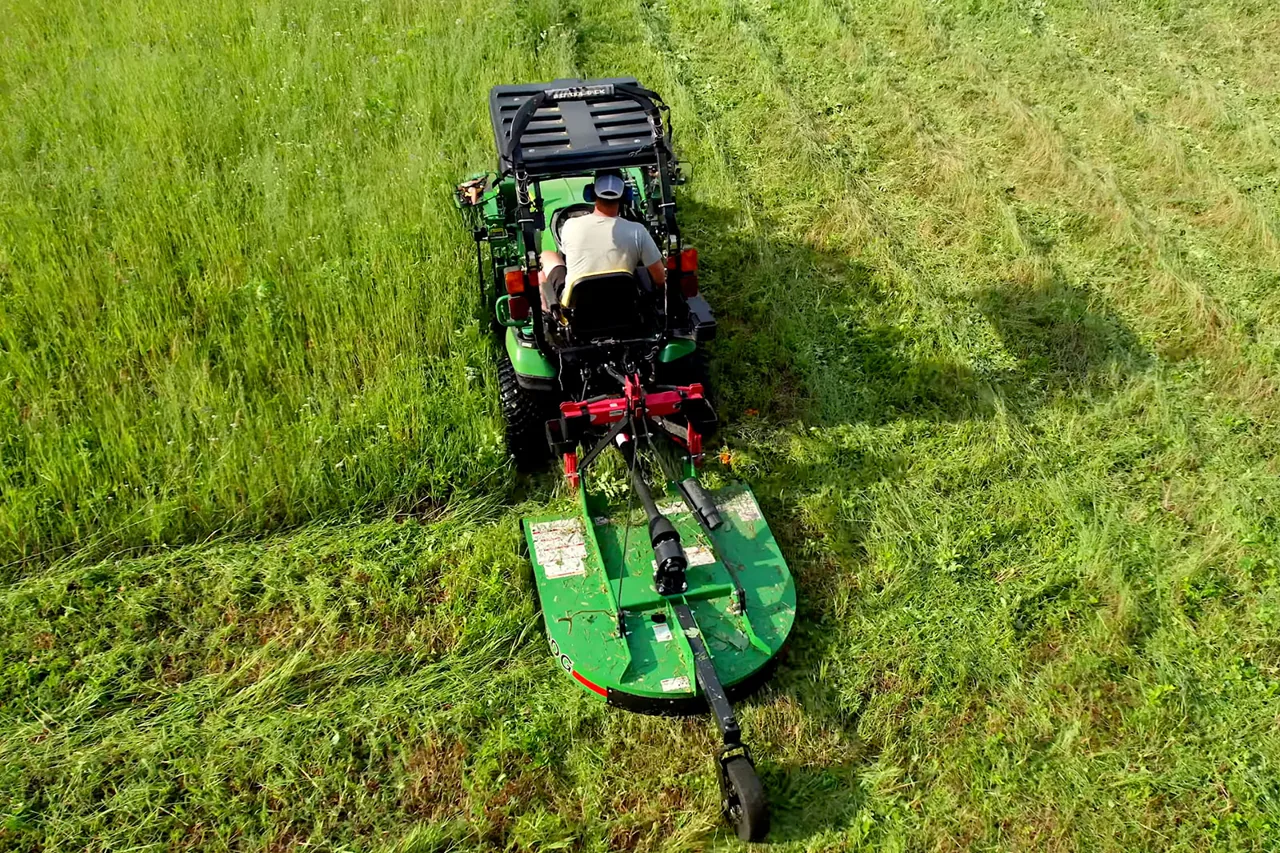
The two meet through pace. A single-spindle cutter on a compact tractor covers about 1 to 1.5 acres an hour in grass, closer to 2 or 2.5 on a flat, dry field with a wider deck, and heavy brush can pull it down to an acre an hour. So a $100-an-hour tractor is a $100-an-acre job in thick growth and closer to $50 on clean pasture. Price sheets from South Carolina and North Florida bake stem size into the hourly rate: $60 to $75 an hour for grass and fields, $70 to $90 for brush up to 2 inches, and $95 to $100 for a heavy cutter rated to 4 inches. A 2023 Louisiana outdoors forum thread had Northeast Louisiana tractor work at $125 an hour.
What does bush hogging cost by field condition?
Condition moves the number more than acreage does. A pasture cut within the last year prices near the bottom of the market, thick weeds and light brush sit in the middle, and a field that has been left long enough to grow saplings, privet, and briars can cost three to five times what a maintained one does.
| Field condition | Market range per acre | What it looks like on the ground |
|---|---|---|
| Maintained pasture, growth under about 12 inches | $50–$100 | Cut within the past year, no woody stems, the tractor never slows |
| Moderate overgrowth: tall grass, weeds, light brush | $75–$150 | A missed season; Johnson grass and broomsedge head-high in spots, a few soft stems |
| Heavy overgrowth, saplings under 2 to 3 inches | $150–$250, some Gulf South sheets $300+ | Two or more seasons idle; sweetgum, tallow, and privet stems, briars, hidden debris |
| Lots under 1 acre, any condition | $150–$350 flat | The minimum covers the trip no matter the size |
One Mississippi Gulf Coast operator posts a flat $333 per acre for ground that has reached waist height, with anything under an acre billed as a full acre, and a Central Florida contractor lists $200 to $300 for a single acre against $600 to $1,500 for ten.
Why does a small tract cost more per acre?
Because the trip costs the same whether the cutter runs twenty minutes or all day. Loading the tractor, hauling it, unloading, and setting up eat an hour or two before the first pass, so most operators hold a $150 to $300 minimum per visit and price lots under an acre as a full acre or a flat fee.
Cost guides list travel or mobilization at $20 to $160 on short hauls and up to $400 on long ones. Ten open acres along Highway 425 will nearly always price cheaper per acre than two acres of the same grass split by a ditch and a fence, because the tractor stays in the field instead of turning and reloading.
What makes a bush hogging job more expensive?
Anything that slows the tractor or threatens the cutter. Stems over 2 inches, hidden stumps, rocks and debris, soft ground, slopes, and dense summer growth all push a quote toward the top of the range, and cost guides put the terrain premium alone at 20 to 60 percent over the same acreage on flat, clean ground.
- Stem size. Rates step from grass, to brush under 2 inches, to a heavy cutter for 4-inch material, and past 2 to 3 inches most operators decline the job for a rotary cutter.
- Ground you cannot see. Rocks and stumps under tall grass wear and break blades, so the tract gets walked first and the unknown gets priced in.
- Wet ground. Cutting wet grass on soft soil ruts and tears the field, and big equipment on saturated ground compacts it or gets stuck.
- Slopes. Mowing rates poor on steep grades, so ditch banks and levee slopes cut slower or get skipped.
- Season. Summer foliage is denser, and at least one price sheet says outright that summer jobs cost more.
What can a tractor and rotary cutter actually cut?
Grass, weeds, briars, and woody stems up to the cutter’s rating, which for common single-spindle models is 1 to 4 inches of diameter. Bush Hog, the Selma, Alabama cutter manufacturer, rates its light-duty models at 1 inch on 15 to 25 horsepower tractors and its heaviest single-spindle model at 4 inches on 60 to 70 horsepower.
Between those sit the 2-inch class on 25 to 50 horsepower and the 3-inch class on 35 to 55; the 15-foot flex-wing cutters used on big pasture are rated at 2.5 inches. Ratings are a ceiling, not a working number. Contractors from Texas to Georgia put the practical limit at 2 to 3 inches and warn that driving a cutter into trees past that damages the machine. The cutter leaves 3 to 6 inches of stubble and does nothing below ground, so every stem it cut is still alive at the crown.
When does a job stop being bush hogging and become forestry mulching?
When the stems are bigger than about 3 inches, when there are stumps in the way, or when the owner wants the brush gone rather than knocked down. A tractor cutter tops out around 2 to 3 inches; a forestry mulcher grinds trees of 6 to 8 inches on standard machines and leaves a mulch layer instead of cut stems.
The price gap is wide. HomeAdvisor’s June 2026 figures put forestry mulching at $400 to $1,500 an acre, and $125 to $200 an hour for underbrush and small trees, up to $200 to $400 in heavy brush; contractor guides for wooded ground run $800 to $3,500 an acre. One Florida operator’s sheet shows the jump on a single page: $60 to $95 an hour for the tractor and cutter, $200 to $350 for the mulcher. Mulching is a one-time clearing with regrowth measured in months to years, and its own pricing is covered in our forestry mulching cost per acre guide. Bush hogging is cheaper per pass, but the roots stay and the field comes back in weeks to months. The full decision is in bush hogging versus forestry mulching, our forestry mulching page covers the machine side, and for ground that has gone fully to trees, start with land clearing cost per acre in Louisiana.
How fast does land brush back up in Northeast Louisiana?
Fast. The National Weather Service office that covers Monroe lists a 249-day growing season at its Shreveport station, last freeze around March 10, first freeze around November 15. Sweetgum, Chinese tallow, privet, and Johnson grass all regrow from the root inside that window, so woody sprouts cut in spring can stand head-high again by fall.
A rotary cutter only removes the top, and the local invaders are built to come back. Forest Service data show sweetgum sprouts reaching in one season the height a seedling needs three to five years for, and cut Chinese tallow in coastal Texas at 11 to 12 feet one year after cutting, with root sprouts up to 16 feet from the trunk. Mississippi State’s pasture guide notes that mowing tallow saplings turns one stem into several, and Louisiana is one of the three states most invaded by it. Privet sprouts from the root crown and suckers from shallow roots. Johnson grass regrows from rhizomes and persists under monthly cutting. Broomsedge on tired pasture signals low phosphorus, potassium, and pH, and mowing before it seeds in late summer limits spread but does not fix the soil. That is why Southeastern contractors put pasture and hunting ground on a 6 to 12 month cycle, tighten to 3 to 6 months where saplings are coming, and take 15 to 20 percent off the per-visit rate for a standing schedule. Timing by land use is in how often to bush hog pasture and hunting land in Louisiana.
When is Delta ground too wet to bush hog?
Often through winter and into spring. Richland Parish sits in the Delta, and its Sharkey-type clay has very slow permeability, ponds in backswamps through winter and spring, and cracks open 1 to 3 centimeters wide once it dries. Cutting while it is soft ruts the field and can leave the tractor stuck.
Monroe averages about 54 inches of rain a year, but July through September are the dry months in the 3-inch range while December, January, and May each top 5 inches. East of Rayville the ground changes. Macon Ridge, the loess-capped terrace between the Boeuf and Tensas basins, rises 10 to 30 feet above the floodplain, yet its Calloway and Egypt silt loams are still somewhat poorly drained, with a perched water table within 0.5 to 2 feet of the surface in winter and spring. The well-drained sandy loams of the Coastal Plain hills, the Ruston series being the type, dry out sooner. The cheap, fast window on Delta pasture tends to be late summer through fall; a job that has to happen in a wet March gets quoted for slower ground or waits. Lining up bush hogging and field mowing for the dry months is the simplest way to stay at the low end of the range.
If you have a tract in Richland Parish or anywhere in Northeast Louisiana and want a real number instead of a range, send us the acreage and a few photos along with how long it has been since the last cut. Big Cypress Land & Game works out of Rayville and covers the parishes around it, and a walk on the ground is how a fair per-acre price gets set.