
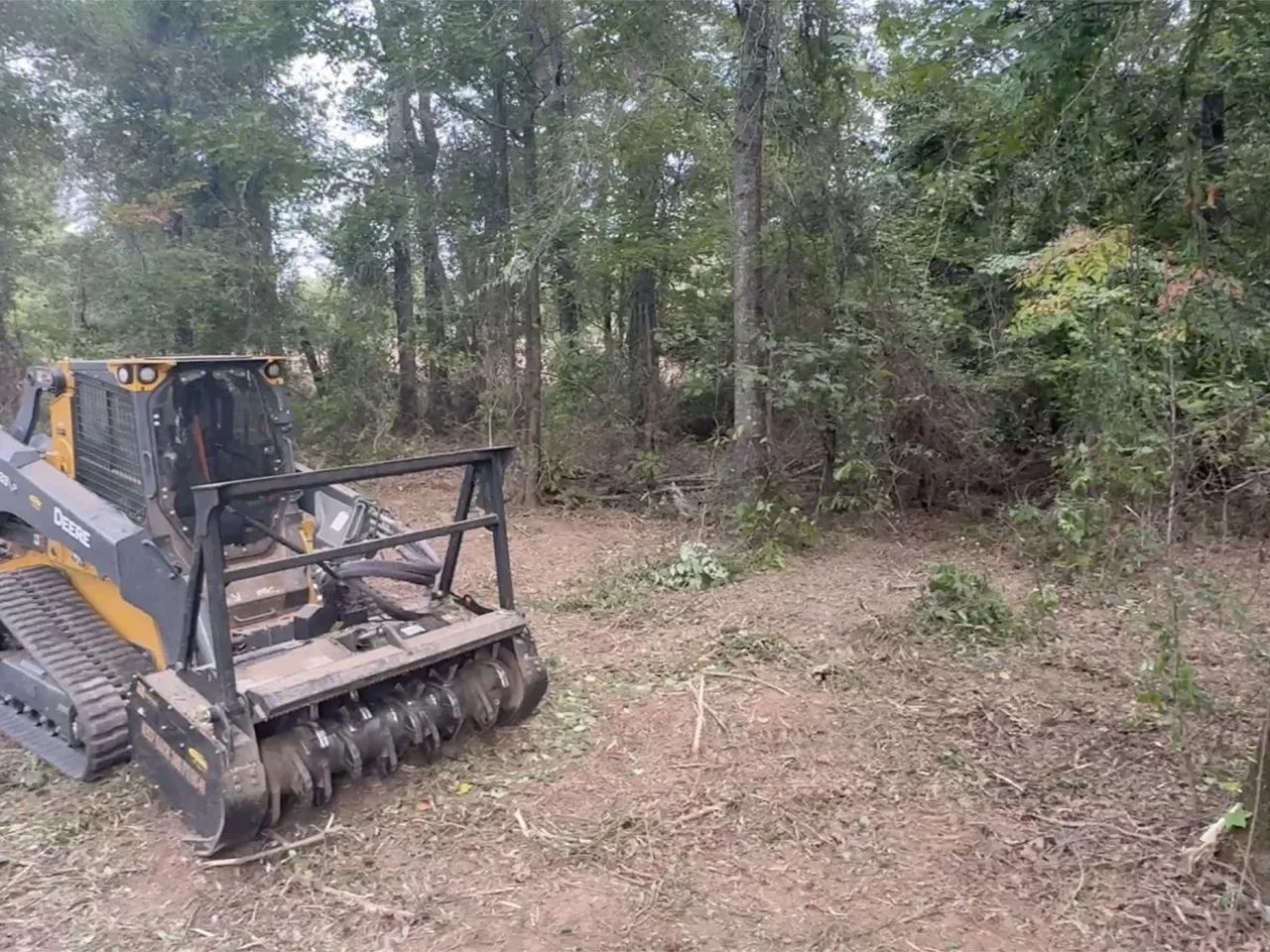
How much does forestry mulching cost per acre in Louisiana?
Forestry mulching runs $400 to $2,000 per acre in national cost guides. A 2026 contractor guide puts Southeast pricing higher, at $1,200 to $3,500 per acre. Hourly rates run $125 to $300 for one machine with an operator. Dense brush and larger stems push that to $300 or $400 an hour. Day rates land near $1,000 to $2,500.
Those are market ranges from published guides, not a price from us. What a tract costs depends on stem size, density, access, and how wet the ground is. Our forestry mulching work around Rayville and Northeast Louisiana gets quoted after a look at the ground.
How is forestry mulching priced: per acre, per hour, or per day?
All three are common, and the tract decides. Per acre pricing suits open, even ground where an operator can hold a steady pace. Hourly pricing fits odd tracts, mixed stem sizes, and selective work. Day rates and deployment fees show up on rural jobs where moving the machine is a real cost.
A published Oklahoma price sheet lists $200 an hour with a three hour minimum. A full eight hour day there is $1,600. An eastern North Carolina contractor sells a peak season deployment at $3,500 for six hours of machine time. Past that it is $250 an hour. In their slow season the deployment drops to $1,500 to $2,000.
The two meet through pace. A skid steer mulcher clears about 1 to 3 acres a day in most conditions. One equipment maker says 3 acres in eight hours is easy in light brush on level ground. Heavy timber can drop the same machine to a half acre a day. We run a compact track loader with a forestry mulching head, so pace on your ground sets the hours.
What does forestry mulching cost per acre by brush density?
Density sets the number more than acreage does. Light brush and briars run cheapest. Stems in the 4 to 8 inch range take more passes and cost two to three times as much. Once trees pass what the head can eat, mulching stops being the cheap option.
| Brush density | Published range per acre | What it looks like on the ground |
|---|---|---|
| Grass and light brush, stems under 2 inches | $500 to $2,000 | Old pasture, briars, seedling sweetgum, fence lines and trails |
| Medium brush and saplings under 4 inches | $1,500 to $3,500 | A tract idle five years, privet and tallow thickets, scattered pine |
| Heavy brush and small trees, 4 to 8 inches | $3,000 to $6,000 | Grown up bottomland, vines, stems the head takes in passes |
| Dense timber over 8 inches | $4,000 to $8,000 and up | Mature hardwood, where a mulcher alone stops making sense |
Out of state price sheets land in the same place. A Texas company posts $1,500 to $2,500 an acre for light brush and $4,000 to $5,000 for heavy. A Missouri sheet runs $1,500 to $2,000 for light brush with 1 to 4 inch stems. Mature cedar at 8 to 14 inches goes to $3,000 to $4,500 there.
Small tracts cost more per acre. Guides list minimums of $1,000 to $2,500 no matter the lot size. Hauling the machine to your gate costs the same either way. For heavier ground that needs more than a mulcher, see what full land clearing costs per acre in Louisiana.
What moves the number on a Louisiana tract?
Stem diameter does the most work on a quote. A standard flow machine at 15 to 25 gallons per minute handles material up to about 4 inches. High flow at 30 to 40 gallons per minute takes 6 to 8 inch trees. Anything larger needs a bigger carrier, or a different plan.
- Density. More stems per acre means more passes, and mulching time climbs with every pass.
- Ground conditions. Soft Delta clay slows a machine down and can stop it outright.
- Access. A tight gate or a long haul in adds $500 to $1,500 in setup on published guides.
- Acreage. A Texas sheet falls from $2,500 to $4,000 an acre under one acre. Past twenty acres it lists $1,200 to $2,500.
- The finish you want. A fine mulch layer takes extra passes, and extra passes cost time.
- Selective work. Leaving hardwoods or a shooting lane standing slows the machine down.
Why does the wet season change the price here?
Delta clay holds water. Sharkey clay, a common Delta floodplain soil, is 60 to 90 percent clay with very slow permeability. NRCS records ponded areas under a half foot to five feet of water through winter and spring. A machine that sinks does not mulch.
Richland Parish splits in two. The western half sits in the Ouachita and Boeuf floodplain at 60 to 75 feet elevation. The eastern half rides Macon Ridge, about 30 feet higher, on silt loam. Ridge ground dries first, so it opens up earlier in the year.
Rainfall says the rest. National Weather Service normals for Monroe put August at 2.97 inches and September at 3.23. December, June, January, and March all run over 5 inches. Late summer through fall is the dependable window, and a job quoted for a wet month gets priced slower.
What grows back after mulching, and what does that cost later?
A mulcher cuts stems at or near the ground and leaves the roots. Sweetgum, Chinese tallow, privet, and briars all come back from the root. So a mulched tract needs a maintenance plan, and that plan is part of the real cost.
Forest Service data show a single sweetgum root system carrying 40 or more stems. Mississippi State reports that mowing tallow saplings turns one stem into several. Tallow is reproductive in three years and makes up to 100,000 seeds a year. The roots have to be killed to stop the resprouting.
That is why a mulched tract usually goes on a mowing cycle. A rotary cutter keeps sprouts down for a fraction of the mulching price. Our guide to bush hogging prices in Northeast Louisiana has those numbers. For the tool comparison, read which machine fits an overgrown field.
Do you need a permit to mulch land in Louisiana?
It depends on the ground. Dry upland clearing on your own property usually needs no state permit. Wetlands are the exception. Section 404 of the Clean Water Act covers discharges into waters of the United States. That includes dredged or fill material, and mechanized land clearing can count.
Federal rules put the burden of proof on the person doing the mechanized land clearing. They have to show the work will not destroy or degrade waters of the United States. The Vicksburg District of the Army Corps handles Section 404 for Northeast Louisiana and neighboring parts of Arkansas and Mississippi.
Mulching has one advantage on the rules side. It leaves chips on the ground instead of a burn pile. Louisiana’s open burning rule does allow land clearing burns under set conditions. Fires have to sit at least 1,000 feet from any dwelling. Burning runs only between 8 a.m. and 5 p.m. Prevailing winds must blow away from any city or town. Skipping the pile skips all of that.
If any dirt work follows the mulching, Louisiana law requires a locate request first. Notice goes to the regional center at least 48 hours ahead, weekends and holidays excluded. Our post on land clearing permits in Louisiana goes further into the rules.
When is forestry mulching the wrong tool?
When you need bare, gradeable dirt. A mulching head shaves stems at grade and grinds stumps close to it. It does not pull roots out of the ground. Building pads, pond dams, septic fields, and driveways need the stumps and root balls gone.
Drum heads leave a fine mulch and cut stumps near grade, so the stump itself stays underground. Taking a stump below grade is separate stump grinding work. Pulling root balls takes a dozer or excavator crew. We do not own a dozer or an excavator, and we tell you when a job needs one.
Merchantable timber is the other case. Grinding a stand of sawlogs into mulch throws away what a timber buyer would pay for. On the other end, a field of grass and light brush does not need a mulcher at all. Bush hogging and field mowing handles that for far less. For the jobs that need more machine, see our land clearing and reclamation work.
How do you get an accurate mulching quote?
Give the contractor four things: acreage, photos, access, and your goal for the ground. Acreage from a plat or a mapping app beats a guess. Photos of the thickest part of the tract matter more than photos of the edge.
Say how you plan to use the land afterward. A food plot needs less work than a building pad. Note the gate width and whether a truck and trailer can turn around. Those four inputs move a quote from a range to a number.
Have a tract in Richland Parish or anywhere in Northeast Louisiana? Send us the acreage and a few photos. Big Cypress Land and Game works out of Rayville and covers the parishes around it. Estimates on site are free. Call (318) 235-7597.