
Louisiana burn ban rules: can you burn brush on your land?
It depends on what is in the pile and where your land sits. A burn ban can also stop open burning in your area until fire risk drops. Louisiana’s outdoor burning rule is LAC 33:III.1109. It starts by banning outdoor burning of waste or other combustible material on property you own or control. Natural vegetation is the case the rule treats separately, through exceptions that come with conditions. Trash, tires, plastics, shingles and buildings never qualify. Before you light a brush pile, check for a state or parish burn ban and your local rules.
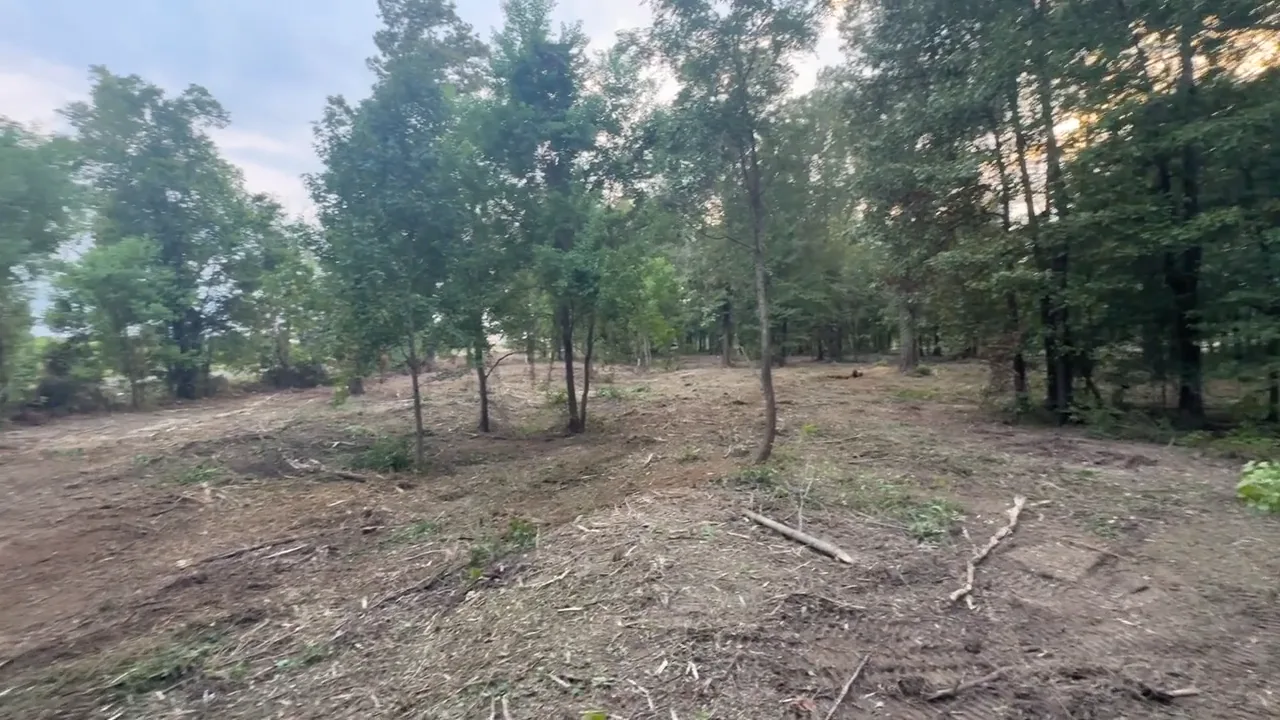
Read this as a plain guide to the rules, not legal advice. Our brush clearing work leaves the brush on your land. It gets ground into mulch where it stands, or stacked with the grapple where you choose. Whether a pile ever gets lit stays your call.
What does Louisiana’s outdoor burning rule say?
The rule sits in Title 33, Part III of the Louisiana Administrative Code. The Louisiana Department of Environmental Quality (LDEQ) wrote it. No person may cause or allow outdoor burning of waste or other combustible material on property he owns or controls. The exceptions are the ones listed in its sections C and D.
LDEQ spells out what that means for a trash pile. Burning household waste, construction debris or anything other than vegetative matter violates the law.
Which exceptions cover leaves, brush and trees?
Section C lists exceptions the rule calls statutory. Two of them cover brush and yard waste, and both turn on parish population.
- Yard waste. This covers leaves, grass, twigs, branches and vines a private owner burns on his own property, for noncommercial purposes. It applies in parishes with 300,000 people or fewer. The owner has to attend the burn at all times. It does not apply in East Baton Rouge Parish.
- Trees and brush. Burning trees, brush, grass or other vegetable matter is exempt in any parish with 90,000 people or fewer. The burn cannot be inside the limits of a city or town. It also cannot be close enough to one that the smoke affects the town’s air.
Because the two population lines differ, the same pile can fall under different exceptions in two parishes. LDEQ’s Northeast Regional Office in Monroe serves Richland, Ouachita, Concordia and nearby parishes. You can call that office with environmental questions about your land.
What conditions does a land-clearing burn have to meet?
Section D adds an exception for trees, brush, grass and other vegetable matter from land clearing and right-of-way maintenance. It applies outside rural parks and recreation areas, and only when every condition is met:
- The prevailing wind blows away from any city or town whose air the smoke could affect.
- The fire sits at least 1,000 feet (305 meters) from any home. Homes and structures on the property where you burn are the exception.
- Care is taken to keep dirt on the burned material to a minimum.
- Heavy oils, asphalt materials and anything with natural or synthetic rubber stay off the fire. So do other non-plant materials that make unreasonable amounts of smoke. None of them can be used to start it.
- The burn runs only between 8 a.m. and 5 p.m. Piles should be small enough to burn down in that window.
- Smoke stays controlled so it does not create a traffic hazard.
Every section D exception carries two more strings. The burn cannot create a public nuisance. It also has to follow other laws and the orders of any government with jurisdiction. The rule adds that the exception does not excuse the person responsible from damage or injuries the burn causes. Section E separately bans smoke that drifts across a public road and creates a traffic hazard by cutting visibility.
What can and cannot go on a burn pile in Louisiana?
The table pulls the state rule and LDEQ’s never-burn list together. Local rules can add more.
| On the pile | What the rules say | Where it comes from |
|---|---|---|
| Leaves, grass, twigs, branches and vines | An exception covers a private owner’s noncommercial burn in parishes of 300,000 or fewer, attended at all times | LAC 33:III.1109, section C |
| Trees, brush, grass and other vegetable matter | An exception covers parishes of 90,000 or fewer, outside towns and away from town air | LAC 33:III.1109, section C |
| Trees and brush from land clearing | An exception applies only when every section D condition is met | LAC 33:III.1109, section D |
| Household waste and construction debris | Burning anything other than vegetative matter violates the law | LDEQ |
| Plastics, tires and other rubber | Never burn | LDEQ never-burn list |
| Paints and household or farm chemicals | Never burn | LDEQ never-burn list |
| Asphalt shingles, heavy oils and wire | Never burn | LDEQ never-burn list |
| Newspaper, cardboard and other paper | Never burn | LDEQ never-burn list |
| Buildings and mobile homes | Never burn | LDEQ never-burn list |
The State Fire Marshal’s reminder is shorter. Where local rules allow open burning, the only legal things to burn in Louisiana are vegetation and ordinary yard waste. Its examples are leaves, tree branches and grass clippings.
Who issues a burn ban in Louisiana?
State and local governments both do. The Louisiana Department of Agriculture and Forestry (LDAF) says state and local authorities set bans when fire risk runs high. A ban stops open burning in an area until the risk drops.
The August 2023 statewide ban came from LDAF’s commissioner and the State Fire Marshal together. During extremely dry weather, they issued a cease and desist order for all private burning, citing R.S. 40:1602. Under that order:
- Private burning needed permission from the local fire department or local government.
- Prescribed burns by LDAF, or by people LDAF trained and certified, were not covered.
- Barbecue grills, fire pits and small campfires for brief recreational use were not affected.
- A violation of the Fire Marshal order could bring criminal or civil penalties.
That order shows how a statewide ban works. It is not a statement of what is in effect today, so read the current order for its terms.
LDAF also issues agricultural burn bans. LDAF defines agricultural burning as burning to reduce crop residue, stimulate yield or control disease and pests. LDAF says it is not burning piles of debris on land, and not clearing land for development. When you hear about a ban, find out which kind it is.
Parishes and cities can set their own bans. LDAF says local rules may be stricter than the state’s, so consult your local government before open burning.
Is there a burn ban in Louisiana right now?
Bans follow fire risk, so check on the day you plan to burn. The 2023 statewide order took effect at 5 p.m. on the day it was announced.
- Start with LDAF. Its Fire Conditions and Burn Bans page links to a burn ban map and a fire danger map.
- Then ask locally. Call your parish government or local fire department.
LDAF recommends checking fire conditions and burning safely even when no ban is in place.
Where do prescribed and agricultural burning fit?
Prescribed burning runs on its own track in Louisiana. LDAF calls it a management practice for forestry, agriculture and wildlife habitat. Since 1993, LDAF has run the Louisiana Certified Prescribed Burner Program, and the LSU AgCenter teaches the formal courses.
Under La. R.S. 3:17.1, a non-certified burner gives LDAF’s Office of Forestry the burn’s location, date and time. That notice goes in 24 to 72 hours ahead. For that kind of burn, start with LDAF’s Prescribed Burning page. It links to a list of certified burners.
The state burning rule sets farm and forest burns apart too. Its section C exempts burning agricultural by-products in the fields and controlled burning for timber stand management. Controlled burning of pasture or marsh for trapping or livestock is on that list as well. We leave that track to LDAF and certified burners.
How can you clear brush without burning it?
Burning is one way to deal with brush. Our work gives you other options, and each one leaves the brush on your property.
- Mulch it in place. The forestry mulching head on our compact track loader grinds brush and saplings where they stand. The chips stay on the ground as mulch, with no pile left to burn.
- Cut it back. Grass and light brush go under our tractor’s rotary cutter. Regular bush hogging helps keep an opened field from going back to brush.
- Pile it for later. The grapple on the loader picks up limbs, loose brush and old piles and stacks them where you choose. Pick that spot with the rules in mind, such as the 1,000-foot distance from any home off the property.
Our part ends with the pile stacked where you want it. Lighting it, and checking the rules first, stays with you.
After a storm, the same grapple and mulching work handles downed limbs and tops in storm cleanup. When the goal is opening ground for a new use, the job moves into land clearing. For wetland, stormwater and other clearing permits, see our guide to land clearing permits in Louisiana.
Big Cypress Land and Game works out of Rayville across Northeast Louisiana. Call (318) 235-7597 for a free on-site estimate on your brush.