
What should you do to your land before you sell it?
Fix legal access, get the lines surveyed and painted, open the entrance, mow what can be mowed, and haul off junk. Those reliably return more than they cost. Ponds, food plots, and trails help on recreational tracts but rarely return every dollar. Cabins, fancy barns, paved roads, and clear-cutting the timber usually do not.
Brokers and rural appraisers agree on the pattern: money spent removing doubt pays, and money spent on personal taste does not. A buyer needs to reach the tract, see where it ends, and picture what it can become, which is why access, a survey, and selective land clearing top the list. That is the whole job when you are buying or selling land in Louisiana.
What do buyers actually pay for on rural land?
Buyers pay for use. An appraiser quoted by Rethink Rural put it plainly: an improvement adds value when it enhances the land’s true use potential and the buyer’s understanding of it. Access, boundaries, visibility, and water all do that. A cabin built to your taste, or a road nicer than the land needs, usually does not.
Landco, a Midwest land brokerage, says material improvements rarely return their full cost, and the ratio matters: a $40,000 shed is a rounding error on a million-dollar farm and an anchor on a $50,000 parcel. Coulee Land Company claims hunt-ready tracts bring a 10 to 15 percent premium over raw land. The buyer pays for certainty about what the land can do, not for your spending.
Does fixing access pay before a sale?
Yes, and nothing else comes close. National Land Realty calls poor access one of the biggest hurdles in any land sale, and Landmodo’s buyer guide puts the discount on a landlocked parcel at 30 to 60 percent against a comparable tract with road access. A recorded easement, a gravel entrance, and a gate cost a fraction of that.
Legal access comes first. If your route in crosses a neighbor, get it into a recorded easement rather than a handshake; Landmodo notes most lenders will not lend on a landlocked parcel, and an easement can run from a few hundred dollars to tens of thousands. Then make the entrance and main road passable in a pickup after rain, and keep it practical; Landco says many buyers disregard asphalt or white rock roads entirely. Current guides put gravel road at $10 to $30 per linear foot and a quarter mile at about $5,300 to $15,800, with culverts or drainage adding $2,000 to $5,500. A well-built gravel entrance and access road is the one improvement a buyer sees from the parish road.
Should you survey and mark the lines before listing?
If your last survey is older than a few years, yes. Buyers’ lenders often require a recent one anyway, so the seller who orders it early controls the timing and finds problems before a buyer does. Painted lines and flagged corners cost almost nothing and let a prospect walk the tract without a guide.
Whitetail Properties notes the only guarantee of accurate acreage is a survey, which also turns up encroachments and unrecorded easements. Landmodo says a seller’s survey is generally usable if it is within about three to five years and prices boundary work at $1,500 to $5,000 for 10 to 50 acres and $6,000 to $12,000 or more above that. Open title at the same time so old easements, restrictions, and ownership questions surface while there is time to fix them; KW Land notes a new survey is typically a seller expense anyway.
Should you clear the whole tract or just mow it?
Mow and open it up; do not bulldoze it flat. Bush hogging runs roughly $50 to $250 an acre and makes a tract walkable and photographable. Full clearing runs $600 to $6,200 an acre and pays only where it creates a homesite, pasture, or food plot the buyer wants. Standing timber and cover are part of the value.
The presentation work is cheap. Mow the entrance, the road edges, and any open ground, and mulch a loop trail so a buyer can see the back of the tract without a machete. Acres.com calls removing junk and old buildings one of the easiest ways to raise land value, and the standard is a place that looks cared for, not manicured.
Heavier clearing needs a reason. Current guides put lightly wooded land at roughly $600 to $2,300 an acre and heavily wooded land at $3,300 to $6,200, with forestry mulching averaging near $400 to $450. Spend that only where it converts acreage into something a buyer will pay for: a homesite with a view, a pasture, or plots and lanes on a hunting tract. Our land clearing cost breakdown for Louisiana covers what drives those numbers.
Do ponds and habitat work pay at closing?
Sometimes, and mostly on smaller tracts. A study of southeastern land sales reported by American Forest Management found ponds raised bare land value 6 percent on average, from zero to 42 percent, and cut days on market by about 50. The lift was 7.7 percent on 50-acre parcels and 1.9 percent on 500 acres.
Weigh that against cost. HomeAdvisor prices a one-acre pond at $7,000 to $25,000, and Landco’s numbers are less kind: a lake built at about $10,000 a surface acre gets valued near $6,000. A new pond is a marketing tool that shortens the sale, not an investment that returns its cost, and it makes sense only with clay, a natural drain, and recreational buyers.
Habitat work follows the same logic. Food plots, screened trails, and a few stands make a hunting tract turnkey, and a lease in place documents income: Forest Resource Consultants puts Southeast hunting leases at $8 to $30 an acre a year, with Mississippi Delta and river-bottom ground at $30 to $50 or more per HuntLease. Keep the plot maps, stand locations, and trail camera photos, because buyers ask for them. Louisiana Department of Wildlife and Fisheries private lands biologists will walk a tract and write a management plan at no charge.
Should you sell the timber before you sell the land?
Usually no. Green Hill Land & Forestry reports clear-cut land takes longer to sell and brings less than land with standing timber, and hardwood takes decades to recover its look. Get a cruise from a consulting forester, list with the timber value documented, and cut first only when the timber is worth more than the bare dirt.
Forestry & Land lists the cases where cutting first makes sense: the timber pushes your price well above comparable sales, a thinning would improve an overly dense pine stand, or the harvest funds the roads and clearing above. Be wary of any agent or forester who pushes a timber sale and earns a commission on it. If you do sell, take sealed bids through a professional: NC State Extension cites research showing landowners with forestry help averaged 23 percent more income per acre, and Mississippi’s forestry commission says sealed bids return the most.
Be honest in the listing. LandThink found seller-supplied timber cruises inflate realizable value by 10 to 50 percent, and buyers hire their own forester to check. The Louisiana Department of Agriculture and Forestry publishes a quarterly stumpage report as a price guide, and in the Timberland Investor’s compilation of TimberMart-South and LSU AgCenter data, fourth-quarter 2025 Louisiana pine pulpwood ran about $4.43 a ton against $23.70 for pine sawtimber. A pulpwood thinning right now is a habitat decision more than a money one.
What should you not do before listing?
Do not build a cabin, pave a road, pour a slab under a barn, clear-cut, or touch anything that might be a wetland. Landco’s broker guidance is blunt: material improvements rarely return their full cost, buyers discount cabins built to someone else’s taste, and many ignore improved roads entirely. Wetland clearing can also bring federal permit trouble.
This matters on any tract with low ground or flooded timber. Section 404 of the Clean Water Act regulates discharging dredged or fill material into waters of the United States, including wetlands, and the Corps of Engineers issues the permits. EPA exempts ongoing farming and forestry, farm ponds, and farm and forest roads built to best management practices, but not work that converts a wetland to upland. A fresh scar in a wet bottom is the first thing a buyer’s due diligence finds; leave low ground alone until someone qualified has looked.
LandBoss’s advice to hunting-land sellers covers the rest: you do not need to over-improve the property, but you should remove doubt.
In what order should the work happen?
Paper first, dirt second, pictures last. Open title, order the survey, record any easement, and get the timber cruised before you spend on equipment, because those steps are slow and they shape the dirt work. Then roads, entrance, junk removal, and mowing. Habitat and pond work only where the buyer pool is recreational. Photograph it clean.
A working sequence:
- Title, survey, recorded easement if needed, timber cruise. Allow at least a month of bid time if you sell timber, per NC State.
- Timber work, since loggers tear up roads, then entrance, gate, main road, culverts, and drainage.
- Junk out, brush hogging, trails mulched, lines painted, then pond and habitat work if the tract warrants it.
- Photos, drone video, and maps, shot in late fall or early spring for visibility, per LandBoss.
| Improvement | Typical market cost | What it tends to do at closing |
|---|---|---|
| Recorded access easement | A few hundred dollars to tens of thousands | Removes a 30–60% landlocked discount; makes the tract financeable |
| Boundary survey and painted lines | $1,500–$5,000 for 10–50 acres; more when wooded | Buyer and lender confidence; usually a seller expense anyway |
| Bush hogging and cleanup | $50–$250 per acre; mobile home teardown $3,000–$7,000 | Cheapest lift in presentation; do it before photos |
| Gravel entrance and main road | $10–$30 per linear foot; quarter mile $5,300–$15,800 | Strong; keep it practical, buyers ignore fancy roads |
| Selective clearing and mulching | Mulching about $400–$450 per acre; full clearing $600–$6,200 | Pays where it creates a homesite, pasture, plot, or lane |
| Pond | $7,000–$25,000 for one acre | About 6% on bare land value on average and a faster sale; rarely full cost back |
| Food plots, trails, stands | Varies with acreage | Turnkey premium on hunting tracts; documented history sells faster |
| Cabin, barn upgrades, paving | High | Rarely returns cost; taste-specific |
| Clear-cutting the timber | Brings cash now | Land sells slower and for less; hardwood takes decades to recover |
These are national cost-guide ranges, not quotes; brush density, soil, haul distance, and tract size move every one.
Does drone imagery help sell land?
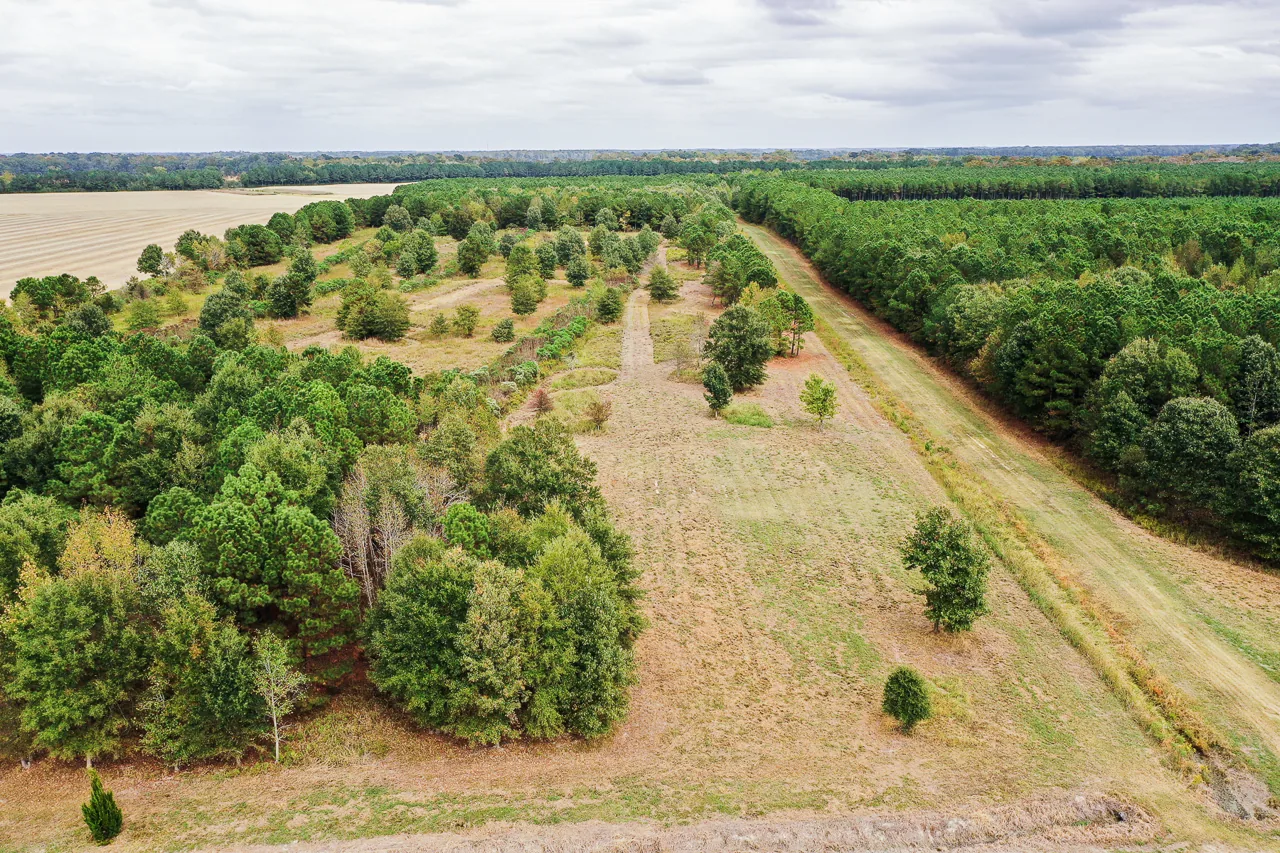
Yes, once the tract is ready to be seen. Aerial photos and video show boundaries, road frontage, interior trails, water, and timber types in one frame, which is exactly what buyers want to know before they drive out. Hunting-land brokers now list drone imagery beside a survey and trail camera photos as standard material.
LandBoss’s seller checklist includes aerial imagery showing terrain and water, a topographic map with the boundary outlined, and trail camera samples. Fly after the mowing and painting, because the camera only shows what is there. Drone mapping with the survey lines overlaid settles the acreage and access questions in one image.
None of this replaces pricing the tract right, but the sequence above is how you avoid paying twice: once for an improvement and once in a discount for the doubt it left behind.
Big Cypress Land & Game does the dirt side of this list out of Rayville: clearing, mulching, roads and entrances, ponds, and habitat work across Northeast Louisiana. Owner Mike Martien is also a land specialist and broker with America’s Land Partners, so he can walk a tract and say which of these steps are worth paying for before it lists and which are not. Get in touch if you want that walk-through before you spend on a tract.